 GPU & Compute
Aqueduct
API and Socket client for ERC dEX with ML workload capabilities.
- Status
- UnmaintainedNo commits in 1175 days.
- Last checked
- Checked · Oct 13, 2026
- License
- Open source
- Pricing
- Free tier
What it is
Aqueduct is a tool designed to facilitate the execution of LLM and ML workloads across various cloud infrastructures. Originally developed as an API and Socket client for ERC dEX, it has evolved to support machine learning operations, including orchestration and monitoring. Despite its potential, the project is no longer actively maintained, which may affect its long-term viability. Aqueduct is implemented in Go and is available under the Apache-2.0 license, indicating its open-source nature.
Combines ML workload orchestration with API client capabilities for ERC dEX.
When it fits — and when it doesn’t
A good fit for
Developers needing an open-source ML orchestration tool
Aqueduct's open-source nature and orchestration capabilities make it suitable for custom ML infrastructure setups.
Projects using Go for backend services
Aqueduct's implementation in Go can be advantageous for teams already using Go.
Look elsewhere if
Teams requiring active support and maintenance
The project is no longer maintained, which could lead to unresolved issues.
Developers needing a tool with a large user community
Low engagement metrics suggest limited community support.
Known weaknesses
Each one links to the public issue, changelog or docs page it came from, where we have one.
- 01
No longer maintained
GitHub description states the project is no longer maintained.
- 02
Zero weekly downloads
NPM data shows 0 weekly downloads.
- 03
Limited recent updates
Last commit was in June 2023.
What it does well
Open-source with Apache-2.0 license
GitHub repository lists Apache-2.0 as the license.
Supports ML workload orchestration
GitHub topics include 'mlops' and 'orchestration'.
Implemented in Go
GitHub repository lists Go as the primary language.
Pricing
- Free tier
- Yes
- Paid from
- —
- Model
- N/A
- Enterprise plan
- No
Pricing last confirmed Sep 30, 2026.
Performance benchmarks
How Fast Is It?
Set up Aqueduct
Setup steps, common gotchas and what to check after 30 days.
Get the badge
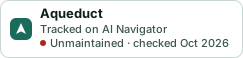
A small badge for Aqueduct’s README or site: its name, “Tracked on AI Navigator”, and the availability status and check month from this page. It updates as the catalog does.
Markdown
[](https://navigateaitools.com/explorer/tool/aqueduct)HTML
<a href="https://navigateaitools.com/explorer/tool/aqueduct"><img src="https://navigateaitools.com/badge/aqueduct.svg" alt="Aqueduct — tracked on AI Navigator" height="58"></a>