 Databases (Core)
DataBend
Unified Data Warehouse for Analytics, Search, AI, and Python Sandbox on S3
- Status
- Generally available
- Last checked
- Checked · Oct 15, 2026
- License
- Open source
- Pricing
- Free tier · from $0
What it is
DataBend is a modern data warehouse designed to handle analytics, search, AI tasks, and provide a Python sandbox environment. It's built from scratch with a unified architecture that integrates seamlessly with your existing S3 storage.
DataBend stands out as a modern, self-hosted data warehouse with built-in support for Python and seamless S3 integration, making it ideal for teams that want flexibility and control over their data processing environment.
When it fits — and when it doesn’t
A good fit for
Teams needing a unified solution for analytics, search, and AI tasks on S3 storage
Projects requiring a modern, self-hosted data warehouse with Python support
Look elsewhere if
Organizations that require real-time streaming capabilities (batch-oriented architecture)
Users looking for cloud-managed services without the need to manage their own infrastructure
Known weaknesses
Each one links to the public issue, changelog or docs page it came from, where we have one.
- 01
Limited language support beyond Python and Rust
Primary SDKs are in Python and Rust, with no official support for other languages like Java or Go
- 02
Small community and limited third-party integrations
GitHub contributions are primarily from the core team, few external contributors; Limited plugins and connectors compared to established data warehouses
What it does well
Unified architecture for analytics, search, and AI tasks
Seamless integration with S3 storage
Supports Python sandbox environment
Built from scratch to ensure modern design principles
Pricing
- Free tier
- YesOpen source — free to use
- Paid from
- $0
- Model
- Flat rate
- Enterprise plan
- No
Pricing not independently confirmed — check the vendor’s page.
Performance benchmarks
How Fast Is It?
Set up DataBend
Setup steps, common gotchas and what to check after 30 days.
Get the badge
A small badge for DataBend’s README or site: its name, “Tracked on AI Navigator”, and the availability status and check month from this page. It updates as the catalog does.
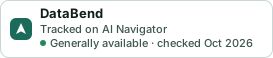
Markdown
[](https://navigateaitools.com/explorer/tool/databend)HTML
<a href="https://navigateaitools.com/explorer/tool/databend"><img src="https://navigateaitools.com/badge/databend.svg" alt="DataBend — tracked on AI Navigator" height="58"></a>