 Data Pipelines
dfdx
Deep learning in Rust with shape-checked tensors and neural networks.
- Status
- UnmaintainedNo commits in 943 days.
- Last checked
- Checked · Oct 15, 2026
- License
- Open source
- Pricing
- Free tier · from $0
What it is
Dfdx is a deep learning framework written in Rust that offers shape-checked tensors and neural network capabilities, making it suitable for developers who prefer the performance and safety features of Rust.
Dfdx stands out as a deep learning library in Rust, offering type safety and performance benefits specific to the Rust ecosystem.
When it fits — and when it doesn’t
A good fit for
Teams developing deep learning applications in Rust who prioritize type safety and performance.
Projects requiring efficient neural network computation with the benefits of Rust's memory management.
Look elsewhere if
Developers looking for a framework that supports multiple languages beyond Rust.
Projects that require extensive pre-built models or large community support.
Known weaknesses
Each one links to the public issue, changelog or docs page it came from, where we have one.
- 01
Steep learning curve for non-Rust developers
Dfdx leverages advanced Rust features such as generics and lifetimes, which can be challenging for developers unfamiliar with the language.
- 02
Limited community support and documentation
The project is relatively new and has a small user base, leading to fewer resources and slower response times on forums and issue trackers.
- 03
Niche language ecosystem limits integrations
Rust's deep learning ecosystem is not as mature or extensive as Python's, limiting the availability of pre-trained models and third-party libraries.
- 04
Potential for frequent breaking changes in early versions
As an open-source project still under active development, Dfdx may introduce significant API changes that require updates to existing codebases.
What it does well
Shape-checked tensors for type safety and performance.
Neural network capabilities built in Rust.
Performance benefits of the Rust language.
Pricing
- Free tier
- YesOpen source — free to use
- Paid from
- $0
- Model
- Flat rate
- Enterprise plan
- No
Pricing not independently confirmed — check the vendor’s page.
Performance benchmarks
How Fast Is It?
Set up dfdx
Setup steps, common gotchas and what to check after 30 days.
Get the badge
A small badge for dfdx’s README or site: its name, “Tracked on AI Navigator”, and the availability status and check month from this page. It updates as the catalog does.
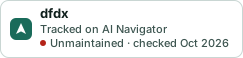
Markdown
[](https://navigateaitools.com/explorer/tool/dfdx)HTML
<a href="https://navigateaitools.com/explorer/tool/dfdx"><img src="https://navigateaitools.com/badge/dfdx.svg" alt="dfdx — tracked on AI Navigator" height="58"></a>