 Model Hubs & Serving
G2O
General framework for graph optimization in robotics and computer vision
- Status
- Generally available
- Last checked
- Checked · Oct 16, 2026
- License
- Open source
- Pricing
- Free tier · from $0
What it is
G2O is a powerful general framework for graph-based optimization problems, widely used in robotics and computer vision applications. It provides efficient algorithms to solve non-linear error functions between variables connected by edges.
G2O stands out by offering a modular and efficient framework specifically tailored for graph-based optimization problems in robotics and computer vision, making it an ideal choice for researchers and developers working on complex localization and mapping tasks.
When it fits — and when it doesn’t
A good fit for
Robotics teams working on SLAM algorithms who need efficient graph-based optimization
Computer vision researchers implementing SfM techniques requiring robust error minimization
Academic projects focusing on pose graph optimization and localization
Look elsewhere if
Applications that require real-time processing without the flexibility to optimize for specific use cases
Projects with strict memory constraints, as G2O may not be optimized for minimal resource usage
Known weaknesses
Each one links to the public issue, changelog or docs page it came from, where we have one.
- 01
Steep learning curve for new users
G2O's documentation assumes a strong background in graph optimization and robotics, making it challenging for beginners to understand and implement.
- 02
Limited language support beyond C++
While G2O is written in C++, there are no official bindings or libraries provided for other languages such as Python or Java, limiting its accessibility to developers who prefer these languages.
- 03
Complex setup process
Setting up the environment and dependencies for G2O can be cumbersome, especially on non-standard platforms or configurations, leading to potential frustration during initial integration into projects.
- 04
Performance issues with large-scale problems
G2O may suffer from performance degradation when dealing with very large graphs due to its memory management and optimization algorithms, which can be a bottleneck in real-time applications.
What it does well
Efficient graph-based optimization algorithms
Support for various types of constraints and variables
Modular design allowing easy integration into robotics and computer vision projects
Pricing
- Free tier
- YesOpen source — free to use
- Paid from
- $0
- Model
- Flat rate
- Enterprise plan
- No
Pricing not independently confirmed — check the vendor’s page.
Performance benchmarks
How Fast Is It?
Set up G2O
Setup steps, common gotchas and what to check after 30 days.
Get the badge
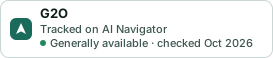
A small badge for G2O’s README or site: its name, “Tracked on AI Navigator”, and the availability status and check month from this page. It updates as the catalog does.
Markdown
[](https://navigateaitools.com/explorer/tool/g2o-general-framework-for-graph-optomization)HTML
<a href="https://navigateaitools.com/explorer/tool/g2o-general-framework-for-graph-optomization"><img src="https://navigateaitools.com/badge/g2o-general-framework-for-graph-optomization.svg" alt="G2O — tracked on AI Navigator" height="58"></a>