 Frontend Frameworks
goa
Design-first Go framework for API code generation and deployment.
- Status
- Generally available
- Last checked
- Checked · Oct 10, 2026
- License
- Open source
- Pricing
- Free tier · from $0
What it is
Goa is a design-first framework that generates API code, documentation, and clients from a single DSL definition. It supports both HTTP and gRPC services ensuring zero drift between code and docs.
Goa stands out by providing a design-first approach with automatic generation of code, documentation, and clients from a single DSL definition, ensuring consistency across all aspects of API development.
When it fits — and when it doesn’t
A good fit for
Teams building RESTful and gRPC services who need consistent documentation and clients
Projects requiring automatic generation of API code and client libraries from a single source
Developers aiming to reduce drift between API implementations and their documentation
Look elsewhere if
Projects that require real-time data streaming capabilities beyond HTTP/gRPC
Teams preferring manual control over the entire API development lifecycle without automation
Known weaknesses
Each one links to the public issue, changelog or docs page it came from, where we have one.
- 01
Steep learning curve for non-Go developers
The tool is deeply integrated with Go language features and idioms, requiring significant familiarity to use effectively.
- 02
Limited community support and small user base
Compared to other API design tools like OpenAPI or Swagger, Goa has a smaller community which can result in fewer resources and slower issue resolution.
- 03
Documentation is sparse and not beginner-friendly
The official documentation lacks detailed examples and explanations for advanced use cases, making it difficult for new users to get started.
- 04
Performance overhead due to code generation at runtime
Generated code can introduce additional latency and complexity in the application, impacting overall performance.
What it does well
Design-first approach with a single DSL definition
Automatic generation of API code, documentation, and clients
Support for both HTTP and gRPC services
Ensures zero drift between code and documentation
Pricing
- Free tier
- YesOpen source — free to use
- Paid from
- $0
- Model
- Flat rate
- Enterprise plan
- No
Pricing not independently confirmed — check the vendor’s page.
Performance benchmarks
How Fast Is It?
Set up goa
Setup steps, common gotchas and what to check after 30 days.
Get the badge
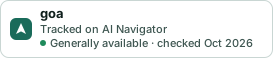
A small badge for goa’s README or site: its name, “Tracked on AI Navigator”, and the availability status and check month from this page. It updates as the catalog does.
Markdown
[](https://navigateaitools.com/explorer/tool/goa)HTML
<a href="https://navigateaitools.com/explorer/tool/goa"><img src="https://navigateaitools.com/badge/goa.svg" alt="goa — tracked on AI Navigator" height="58"></a>