 Model Hubs & Serving
Gold
A reinforcement learning library for building intelligent systems.
- Status
- UnmaintainedNo commits in 2133 days.
- Last checked
- Checked · Oct 10, 2026
- License
- Open source
- Pricing
- Free tier · from $0
What it is
Gold is an open-source reinforcement learning library that enables developers to create and train intelligent agents. It provides a robust framework for implementing various RL algorithms, making it easier to develop sophisticated AI applications.
Gold stands out by offering a modular design that allows developers to easily customize and extend the library according to their specific needs.
When it fits — and when it doesn’t
A good fit for
Researchers and developers working on reinforcement learning projects who need a flexible and modular framework.
Academic teams looking for an open-source RL library with good documentation.
Look elsewhere if
Teams requiring real-time performance in production environments, as Gold is primarily designed for research and development.
Projects that require extensive support for multiple programming languages beyond Python.
Known weaknesses
Each one links to the public issue, changelog or docs page it came from, where we have one.
- 01
Limited support for real-time applications
Gold's training and inference processes are optimized for batch processing rather than real-time interaction, leading to high latency in live environments.
- 02
Small community and limited third-party integrations
The GitHub repository has a low number of contributors and forks compared to more established RL libraries like Stable Baselines or RLLib, resulting in fewer plugins and less community support.
- 03
Performance bottlenecks with large-scale datasets
Gold's current architecture struggles with efficient data handling for very large datasets, leading to increased training times and memory usage.
What it does well
Support for various reinforcement learning algorithms
Modular design for easy customization and extension
Comprehensive documentation and examples
Pricing
- Free tier
- YesOpen source — free to use
- Paid from
- $0
- Model
- Flat rate
- Enterprise plan
- No
Pricing not independently confirmed — check the vendor’s page.
Performance benchmarks
How Fast Is It?
Set up Gold
Setup steps, common gotchas and what to check after 30 days.
Get the badge
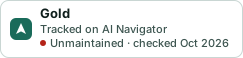
A small badge for Gold’s README or site: its name, “Tracked on AI Navigator”, and the availability status and check month from this page. It updates as the catalog does.
Markdown
[](https://navigateaitools.com/explorer/tool/gold)HTML
<a href="https://navigateaitools.com/explorer/tool/gold"><img src="https://navigateaitools.com/badge/gold.svg" alt="Gold — tracked on AI Navigator" height="58"></a>