 AI Coding Assistants
hashids
Python library for generating YouTube-like IDs from numbers.
- Status
- UnmaintainedNo commits in 2178 days.
- Last checked
- Checked · Oct 10, 2026
- License
- Open source
- Pricing
- Free tier · from $0
What it is
Hashids is a Python implementation of the hashids algorithm that generates short, unique, non-sequential IDs from integers. It's useful for obfuscating database keys and creating user-friendly URLs.
Hashids offers a simple, lightweight solution for generating obfuscated IDs in Python, making it ideal for developers who need to create secure and user-friendly identifiers without complex setup.
When it fits — and when it doesn’t
A good fit for
Developers needing to create short, unique IDs from integers for user-friendly URLs
Projects requiring obfuscation of database keys for security reasons
Look elsewhere if
Applications that require real-time ID generation and processing at scale
Use cases where the length of generated IDs is critical (very short IDs)
Known weaknesses
Each one links to the public issue, changelog or docs page it came from, where we have one.
- 01
Limited language support
Primary implementation is in Python, which may not be suitable for projects using other languages.
- 02
Performance limitations with large datasets
Hash generation can become slow when dealing with a very large number of IDs, impacting real-time applications.
- 03
Complex setup for customization
Customizing alphabet and salt requires careful configuration to ensure uniqueness and security, which can be error-prone.
- 04
Small community support
The project has a relatively small user base compared to more popular ID generation libraries, leading to fewer contributions and slower issue resolution.
What it does well
Generates short, unique IDs from integers
Obfuscates database keys for security and privacy
Supports customization of alphabet and salt
Pricing
- Free tier
- YesOpen source — free to use
- Paid from
- $0
- Model
- Flat rate
- Enterprise plan
- No
Pricing not independently confirmed — check the vendor’s page.
Performance benchmarks
How Fast Is It?
Set up hashids
Setup steps, common gotchas and what to check after 30 days.
Get the badge
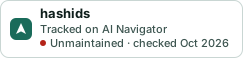
A small badge for hashids’s README or site: its name, “Tracked on AI Navigator”, and the availability status and check month from this page. It updates as the catalog does.
Markdown
[](https://navigateaitools.com/explorer/tool/hashids)HTML
<a href="https://navigateaitools.com/explorer/tool/hashids"><img src="https://navigateaitools.com/badge/hashids.svg" alt="hashids — tracked on AI Navigator" height="58"></a>