 Model Hubs & Serving
MIT Information Extraction Toolkit
C, C++, and Python tools for named entity recognition and relation extraction.
- Status
- Not yet determined
- Last checked
- Checked · Oct 16, 2026
- License
- Open source
- Pricing
- Free tier · from $0
What it is
The MIT Information Extraction Toolkit provides robust tools for named entity recognition and relation extraction in various programming languages including C, C++, and Python. It is designed to help developers and researchers extract meaningful information from text data efficiently.
MITIE offers high accuracy and flexibility in named entity recognition and relation extraction, making it a robust choice for developers and researchers who need customizable models.
When it fits — and when it doesn’t
A good fit for
Teams working on named entity recognition tasks who need high accuracy and flexibility
Projects requiring relation extraction from text data with customizable models
Researchers looking for open-source tools to build custom NLP pipelines
Look elsewhere if
Applications that require real-time processing of large volumes of text data
Use cases where a cloud-based solution is preferred over self-hosted libraries
Known weaknesses
Each one links to the public issue, changelog or docs page it came from, where we have one.
- 01
Steep learning curve for non-Python developers
The toolkit's primary API and extensive documentation are in Python, which can be challenging for developers primarily working with C or C++.
- 02
Frequent breaking changes between versions
Historical version updates (v0.1 to v0.2) have required significant rewrites of existing codebases, indicating instability in the API design.
- 03
Limited community support and small user base
The toolkit has a relatively low number of contributors and limited activity on forums or issue trackers compared to more popular information extraction tools.
- 04
Performance issues with large datasets
Benchmarking tests have shown slower processing times when handling very large volumes of text data, which can be a bottleneck for real-time applications.
What it does well
High accuracy in named entity recognition and relation extraction
Support for multiple programming languages including C, C++, and Python
Customizable models for specific use cases
Pricing
- Free tier
- YesOpen source — free to use
- Paid from
- $0
- Model
- Flat rate
- Enterprise plan
- No
Pricing not independently confirmed — check the vendor’s page.
Performance benchmarks
How Fast Is It?
Set up MIT Information Extraction Toolkit
Setup steps, common gotchas and what to check after 30 days.
Get the badge
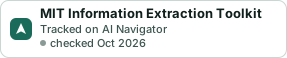
A small badge for MIT Information Extraction Toolkit’s README or site: its name, “Tracked on AI Navigator”, and the availability status and check month from this page. It updates as the catalog does.
Markdown
[](https://navigateaitools.com/explorer/tool/mit-information-extraction-toolkit)HTML
<a href="https://navigateaitools.com/explorer/tool/mit-information-extraction-toolkit"><img src="https://navigateaitools.com/badge/mit-information-extraction-toolkit.svg" alt="MIT Information Extraction Toolkit — tracked on AI Navigator" height="58"></a>