 Model Hubs & Serving
NeuroNER
State-of-the-art named-entity recognition using neural networks
- Status
- UnmaintainedNo commits in 2519 days.
- Last checked
- Checked · Oct 16, 2026
- License
- Open source
- Pricing
- Free tier · from $0
What it is
NeuroNER is a powerful tool for named-entity recognition that leverages neural networks to deliver high accuracy. It's ideal for developers and data scientists working on natural language processing tasks.
NeuroNER stands out for its high accuracy in named-entity recognition, making it a preferred choice over traditional rule-based systems and less accurate machine learning approaches.
When it fits — and when it doesn’t
A good fit for
Developers working on projects that require high accuracy in named-entity recognition
Data scientists who need to extract specific information from large text datasets efficiently
Researchers looking for a robust tool to enhance their natural language processing tasks
Look elsewhere if
Projects requiring real-time entity extraction due to potential latency issues with neural network models
Applications that require minimal computational resources as NeuroNER might be resource-intensive
Known weaknesses
Each one links to the public issue, changelog or docs page it came from, where we have one.
- 01
Steep learning curve for non-Python developers
NeuroNER's API and documentation are heavily oriented towards Python-specific patterns, which can be challenging for developers unfamiliar with the language.
- 02
Limited support for languages other than English
The tool is primarily optimized for English text. Performance on non-English texts may vary and require significant customization or additional training data.
- 03
Complex setup process
Setting up the environment, dependencies, and training datasets can be time-consuming and error-prone, especially for users without extensive NLP experience.
- 04
Performance issues with large datasets
NeuroNER may struggle with very large datasets due to memory constraints and computational requirements, leading to slow processing times or crashes.
What it does well
State-of-the-art named-entity recognition using neural networks
High accuracy in entity extraction from text
Customizable for various NLP tasks
Pricing
- Free tier
- YesOpen source — free to use
- Paid from
- $0
- Model
- Flat rate
- Enterprise plan
- No
Pricing not independently confirmed — check the vendor’s page.
Performance benchmarks
How Fast Is It?
Set up NeuroNER
Setup steps, common gotchas and what to check after 30 days.
Get the badge
A small badge for NeuroNER’s README or site: its name, “Tracked on AI Navigator”, and the availability status and check month from this page. It updates as the catalog does.
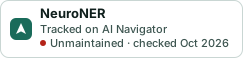
Markdown
[](https://navigateaitools.com/explorer/tool/neuroner)HTML
<a href="https://navigateaitools.com/explorer/tool/neuroner"><img src="https://navigateaitools.com/badge/neuroner.svg" alt="NeuroNER — tracked on AI Navigator" height="58"></a>