 Model Hubs & Serving
nilearn
Machine learning for NeuroImaging in Python.
- Status
- Generally available
- Last checked
- Checked · Oct 16, 2026
- License
- Open source
- Pricing
- Free tier · from $0
What it is
nilearn is a Python module that leverages the scikit-learn API to enable statistical learning on NeuroImaging data. It simplifies common tasks such as image processing, feature extraction, and machine learning model training.
nilearn stands out as the go-to Python library for applying statistical learning techniques to NeuroImaging data, offering a streamlined API familiar to users of scikit-learn.
When it fits — and when it doesn’t
A good fit for
Researchers needing to apply machine learning techniques to fMRI or other neuroimaging datasets
Academic teams who require a Python-based solution for brain imaging analysis
Look elsewhere if
Teams requiring real-time processing of neuroimaging data
Projects that do not involve neuroimaging and are looking for general-purpose machine learning libraries
Known weaknesses
Each one links to the public issue, changelog or docs page it came from, where we have one.
- 01
Limited documentation and examples for advanced use cases
The official documentation lacks detailed guides on complex neuroimaging analyses, leading to a steep learning curve.
- 02
Performance issues with large datasets
Processing and analysis of high-resolution or time-series imaging data can be slow due to memory constraints and computational inefficiencies.
- 03
Limited support for non-Nifti image formats
nilearn primarily supports Nifti format, which may require additional preprocessing steps or external tools to convert other imaging data types.
- 04
Small and niche community
The user base is relatively small compared to more general-purpose machine learning libraries, leading to fewer contributions and slower development cycles.
What it does well
Statistical learning on NeuroImaging data using scikit-learn API
Image processing and feature extraction for neuroimaging datasets
Visualization tools for brain imaging data
Pricing
- Free tier
- YesOpen source — free to use
- Paid from
- $0
- Model
- Flat rate
- Enterprise plan
- No
Pricing not independently confirmed — check the vendor’s page.
Performance benchmarks
How Fast Is It?
Set up nilearn
Setup steps, common gotchas and what to check after 30 days.
Get the badge
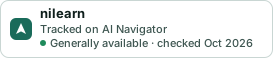
A small badge for nilearn’s README or site: its name, “Tracked on AI Navigator”, and the availability status and check month from this page. It updates as the catalog does.
Markdown
[](https://navigateaitools.com/explorer/tool/nilearn)HTML
<a href="https://navigateaitools.com/explorer/tool/nilearn"><img src="https://navigateaitools.com/badge/nilearn.svg" alt="nilearn — tracked on AI Navigator" height="58"></a>