OCLIF
CLI framework with parser, auto-docs, testing, and plugins.
- Status
- Generally available
- Last checked
- Checked · Oct 10, 2026
- License
- Open source
- Pricing
- Free tier · from $0
What it is
OCLIF is a CLI framework that provides a robust set of features including command parsing, automatic documentation generation, comprehensive testing tools, and plugin support. It streamlines the development process for creating powerful command-line interfaces.
OCLIF stands out with its comprehensive feature set including automatic documentation and testing tools, making it ideal for teams that prioritize robustness and extensibility in their CLI development process.
When it fits — and when it doesn’t
A good fit for
Teams building complex CLI tools that require extensive documentation and testing.
Projects needing a robust framework for plugin-based architecture.
Look elsewhere if
Developers looking for a lightweight, minimalistic CLI tool without advanced features.
Projects requiring real-time interaction or web-based interfaces.
Known weaknesses
Each one links to the public issue, changelog or docs page it came from, where we have one.
- 01
Steep learning curve for non-JavaScript developers
OCLIF is deeply integrated with JavaScript and Node.js patterns, which can be challenging for developers unfamiliar with these ecosystems.
- 02
Limited language support beyond JavaScript
OCLIF is primarily built for Node.js and JavaScript, with limited native support for other languages, which can be a barrier for polyglot teams.
- 03
Complex setup process
Setting up OCLIF requires several steps including installing dependencies, configuring project files, and setting up testing frameworks, which can be time-consuming and error-prone.
What it does well
Command parsing and execution
Automatic documentation generation
Comprehensive testing tools
Plugin architecture for extensibility
Pricing
- Free tier
- YesOpen source — free to use
- Paid from
- $0
- Model
- Flat rate
- Enterprise plan
- No
Pricing not independently confirmed — check the vendor’s page.
Performance benchmarks
How Fast Is It?
Set up OCLIF
Setup steps, common gotchas and what to check after 30 days.
Get the badge
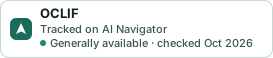
A small badge for OCLIF’s README or site: its name, “Tracked on AI Navigator”, and the availability status and check month from this page. It updates as the catalog does.
Markdown
[](https://navigateaitools.com/explorer/tool/oclif)HTML
<a href="https://navigateaitools.com/explorer/tool/oclif"><img src="https://navigateaitools.com/badge/oclif.svg" alt="OCLIF — tracked on AI Navigator" height="58"></a>