 Observability & Monitoring
ORB-SLAM
Real-time monocular SLAM system for camera-based navigation and mapping.
- Status
- UnmaintainedNo commits in 3542 days.
- Last checked
- Checked · Oct 10, 2026
- License
- Open source
- Pricing
- Free tier · from $0
What it is
ORB-SLAM is a real-time simultaneous localization and mapping (SLAM) library that processes images from a single camera to build a map of the environment while simultaneously tracking the camera's position within it. It is widely used in robotics, augmented reality, and autonomous systems for its robustness and efficiency.
ORB-SLAM stands out due to its efficient use of the ORB feature detector and descriptor, making it particularly suitable for real-time applications where computational resources are limited.
When it fits — and when it doesn’t
A good fit for
Developers working on real-time SLAM systems who need efficient and robust feature extraction.
Robotics teams building navigation systems that require accurate camera tracking in dynamic environments.
Look elsewhere if
Projects requiring real-time video processing with high-resolution cameras, as ORB-SLAM may not scale well.
Applications needing cloud-based SLAM solutions for distributed computing.
Known weaknesses
Each one links to the public issue, changelog or docs page it came from, where we have one.
- 01
Complex setup and configuration
ORB-SLAM requires fine-tuning of parameters for optimal performance, which can be challenging without deep understanding.
- 02
Limited support for non-C++ languages
The primary language is C++, limiting direct integration with projects in other languages such as Python or Java without additional wrappers.
- 03
Performance degradation in highly dynamic environments
ORB-SLAM may struggle to maintain accurate localization and mapping in areas with frequent changes, leading to drift or map inconsistency.
- 04
Resource-intensive for real-time applications on low-power devices
The computational demands of ORB-SLAM can be high, making it less suitable for devices with limited processing power without optimization.
What it does well
Real-time operation for both monocular and stereo cameras.
Efficient feature extraction using ORB (Oriented FAST and Rotated BRIEF).
Robust loop closure detection to maintain map consistency over time.
Supports both monocular and stereo configurations.
Pricing
- Free tier
- YesOpen source — free to use
- Paid from
- $0
- Model
- Flat rate
- Enterprise plan
- No
Pricing not independently confirmed — check the vendor’s page.
Performance benchmarks
How Fast Is It?
Set up ORB-SLAM
Setup steps, common gotchas and what to check after 30 days.
Get the badge
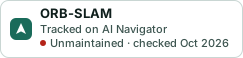
A small badge for ORB-SLAM’s README or site: its name, “Tracked on AI Navigator”, and the availability status and check month from this page. It updates as the catalog does.
Markdown
[](https://navigateaitools.com/explorer/tool/orb-slam)HTML
<a href="https://navigateaitools.com/explorer/tool/orb-slam"><img src="https://navigateaitools.com/badge/orb-slam.svg" alt="ORB-SLAM — tracked on AI Navigator" height="58"></a>