 Model Hubs & Serving
skforecast
Python library for time series forecasting with machine learning models.
- Status
- Generally available
- Last checked
- Checked · Oct 14, 2026
- License
- Open source
- Pricing
- Free tier · from $0
What it is
Skforecast is a Python library designed to facilitate time series forecasting using machine learning regressors compatible with the scikit-learn API. It supports various popular models like LightGBM, XGBoost, and CatBoost, making it versatile for different forecasting needs.
Skforecast stands out by offering a flexible and extensible framework that leverages existing scikit-learn compatible models to perform time series forecasting, making it an ideal choice for developers who want to quickly integrate advanced forecasting capabilities into their projects.
When it fits — and when it doesn’t
A good fit for
Data scientists who need to integrate machine learning models into their time series forecasting workflows.
Developers working on projects that require accurate predictions based on historical data.
Look elsewhere if
Projects requiring real-time or near-real-time forecasting capabilities, as skforecast is designed for batch processing.
Applications where the primary focus is not on machine learning-based forecasting but on other types of analysis.
Known weaknesses
Each one links to the public issue, changelog or docs page it came from, where we have one.
- 01
Limited documentation and examples
The official documentation lacks comprehensive tutorials and practical use cases, making it difficult for new users to get started.
- 02
Small community and limited support
There are few active contributors and a small user base, leading to fewer bug fixes, feature requests, and community-driven improvements.
- 03
Performance issues with large datasets
Skforecast can be slow when processing large time series datasets due to the underlying machine learning models' computational requirements.
What it does well
Supports any regressor compatible with the scikit-learn API.
Integrates well with popular machine learning models like LightGBM, XGBoost, and CatBoost.
Facilitates time series forecasting for various applications.
Pricing
- Free tier
- YesOpen source — free to use
- Paid from
- $0
- Model
- Flat rate
- Enterprise plan
- No
Pricing not independently confirmed — check the vendor’s page.
Performance benchmarks
How Fast Is It?
Set up skforecast
Setup steps, common gotchas and what to check after 30 days.
Get the badge
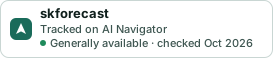
A small badge for skforecast’s README or site: its name, “Tracked on AI Navigator”, and the availability status and check month from this page. It updates as the catalog does.
Markdown
[](https://navigateaitools.com/explorer/tool/skforecast)HTML
<a href="https://navigateaitools.com/explorer/tool/skforecast"><img src="https://navigateaitools.com/badge/skforecast.svg" alt="skforecast — tracked on AI Navigator" height="58"></a>