 Model Hubs & Serving
SKLL
Simplifies scikit-learn experiments for educational and research purposes.
- Status
- UnmaintainedNo commits in 606 days.
- Last checked
- Checked · Oct 12, 2026
- License
- Open source
- Pricing
- Free tier · from $0
What it is
SKLL is a Python library that simplifies the process of conducting machine learning experiments using scikit-learn. It provides an easier interface for setting up, running, and analyzing experiments, making it particularly useful for researchers and educators.
SKLL stands out by providing a streamlined interface for conducting machine learning experiments with scikit-learn, making it particularly useful in educational and research settings.
When it fits — and when it doesn’t
A good fit for
Academic researchers who need a simplified interface for scikit-learn experiments.
Instructors teaching machine learning courses who want to focus on concepts rather than setup.
Projects requiring extensive cross-validation and grid search without manual configuration.
Look elsewhere if
Production environments where performance optimization is critical.
Real-time applications that require low-latency responses.
Known weaknesses
Each one links to the public issue, changelog or docs page it came from, where we have one.
- 01
Limited documentation and community support
The official documentation is sparse, and the community around SKLL is relatively small, making it harder to find solutions for specific issues.
- 02
Performance limitations with large datasets
SKLL's reliance on scikit-learn can lead to performance bottlenecks when processing very large datasets due to memory constraints and computational overhead.
- 03
Narrow focus on scikit-learn integration
The library is tightly coupled with scikit-learn, which limits its utility for users who want to experiment with other machine learning frameworks or libraries.
- 04
Complex setup and configuration
Setting up SKLL requires a good understanding of Python environments and dependencies, which can be challenging for beginners or those unfamiliar with the ecosystem.
What it does well
Simplified experiment setup and execution using scikit-learn.
Support for cross-validation and grid search.
Easy integration with NLTK and other Python libraries.
Comprehensive reporting and analysis tools.
Pricing
- Free tier
- YesOpen source — free to use
- Paid from
- $0
- Model
- Flat rate
- Enterprise plan
- No
Pricing not independently confirmed — check the vendor’s page.
Performance benchmarks
How Fast Is It?
Set up SKLL
Setup steps, common gotchas and what to check after 30 days.
Get the badge
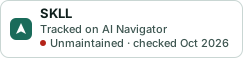
A small badge for SKLL’s README or site: its name, “Tracked on AI Navigator”, and the availability status and check month from this page. It updates as the catalog does.
Markdown
[](https://navigateaitools.com/explorer/tool/skll)HTML
<a href="https://navigateaitools.com/explorer/tool/skll"><img src="https://navigateaitools.com/badge/skll.svg" alt="SKLL — tracked on AI Navigator" height="58"></a>