 Frontend Frameworks
Valvelet
Limit the execution rate of promise-returning functions.
- Status
- UnmaintainedNo commits in 1000 days.
- Last checked
- Checked · Oct 13, 2026
- License
- Open source
- Pricing
- Free tier · from $0
What it is
Valvelet is a utility that allows developers to control and limit the execution rate of asynchronous functions, ensuring they do not exceed specified limits. This helps in managing resource usage and preventing overloading.
Valvelet stands out as a lightweight and easy-to-integrate solution specifically designed to manage the rate of promise-returning function executions in JavaScript projects.
When it fits — and when it doesn’t
A good fit for
Developers working on JavaScript projects who need to control function execution rates.
Teams building web applications that require rate limiting for API calls or background tasks.
Look elsewhere if
Projects requiring real-time processing without any delay.
Applications where the overhead of managing execution rates is not acceptable.
Known weaknesses
Each one links to the public issue, changelog or docs page it came from, where we have one.
- 01
Poor documentation
The official documentation lacks detailed examples and troubleshooting guides, making it difficult for developers to fully understand and utilize Valvelet's features.
- 02
Complex setup process
Integrating Valvelet into existing projects requires significant configuration and may involve modifying multiple parts of the codebase, increasing development time.
What it does well
Limits the execution rate of promise-returning functions.
Can be used to manage resource usage and prevent overloading.
Easy to integrate into existing JavaScript projects.
Pricing
- Free tier
- YesOpen source — free to use
- Paid from
- $0
- Model
- Flat rate
- Enterprise plan
- No
Pricing not independently confirmed — check the vendor’s page.
Performance benchmarks
How Fast Is It?
Set up Valvelet
Setup steps, common gotchas and what to check after 30 days.
Get the badge
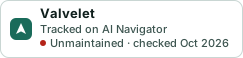
A small badge for Valvelet’s README or site: its name, “Tracked on AI Navigator”, and the availability status and check month from this page. It updates as the catalog does.
Markdown
[](https://navigateaitools.com/explorer/tool/valvelet)HTML
<a href="https://navigateaitools.com/explorer/tool/valvelet"><img src="https://navigateaitools.com/badge/valvelet.svg" alt="Valvelet — tracked on AI Navigator" height="58"></a>